
Hair Restoration Malaysia: The Expert Guide to Natural Hair Restoration at Dr. Ruz Hair Transplant
Seeing more scalp than before can be an unsettling experience. You may did not know that Hair Restoration Malaysia at Dr Ruz Hair Transplants can help you.
At first, you may notice a few extra hairs on your pillow. Then, your hairline may start moving backward. Perhaps the crown becomes thinner, or your hairstyle no longer looks quite the same.
For some people, hair loss becomes much more than an appearance issue. It can influence confidence, self-image, and the way you feel when you look in the mirror.
Fortunately, modern hair restoration has come a long way.
Today, hair restoration Malaysia offers more than simply moving hair from one part of the scalp to another. Instead, successful restoration combines accurate diagnosis, medical treatment, surgical precision, careful donor management, and thoughtful hairline design.
At Dr. Ruz Hair Transplant, we believe that every patient deserves an individual plan. Your hair loss pattern is different from someone else’s. Your scalp anatomy is different too. Therefore, your treatment should never follow a generic formula.
Rather than relying on exaggerated promises, our approach focuses on understanding your hair loss first. We explain the science in simple language, discuss realistic expectations, and then recommend an appropriate treatment strategy.
Whether you have just noticed a receding hairline or you are dealing with advanced baldness, the first step is understanding what is happening beneath the surface.
Hair Loss Starts With Your Biology
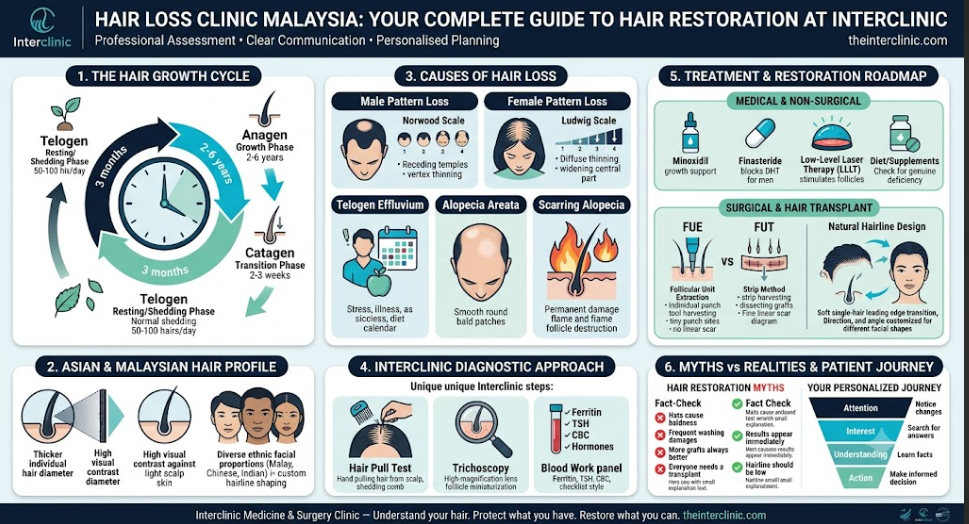
To understand hair restoration Malaysia, it helps to understand how your hair grows in the first place.
Every hair follicle follows a natural cycle. Interestingly, each follicle follows its own schedule, so your entire scalp does not grow and shed hair at exactly the same time.
Scientists generally divide the hair cycle into several stages.
First comes the Anagen phase, which is the active growth stage. During this period, cells within the follicle divide rapidly and produce the hair shaft. This stage can last around three to ten years, and approximately 85% to 90% of scalp hairs may remain in Anagen at any given time.
Next, the follicle enters the Catagen phase. This transition period usually lasts around two to three weeks. During this stage, the follicle begins to shrink and the hair moves away from its active blood supply.
After that, the follicle enters Telogen, the resting phase. This period lasts approximately three to four months before the hair eventually sheds.
Finally, the Exogen phase describes the release of the hair fiber from the follicle.
Importantly, shedding does not mean the follicle has disappeared. The follicle can remain alive beneath the skin and may begin another growth cycle.
However, problems can develop when this cycle becomes disrupted.
Genetics, hormonal sensitivity, physical stress, emotional stress, and other factors can push more follicles into the resting stage at the same time. Consequently, shedding can become more noticeable and thinning can become visible.
That is why early evaluation matters.
When we identify progressive hair loss earlier, we may have a better opportunity to stabilise the situation before further miniaturisation occurs.
What Happens Inside a Hair Follicle? – Hair Restoration Malaysia
Your hair may look simple from the outside. Under the skin, however, each follicle has a sophisticated structure.
Anatomically, the follicle contains several regions.
The upper section is called the infundibulum. It extends from the skin surface toward the opening of the sebaceous gland.
Below that sits the isthmus, which forms the middle permanent portion of the follicle.
Further down lies the inferior segment. This region includes the hair bulb and dermal papilla, which play important roles in producing the hair shaft.
More importantly, scalp hair does not usually grow as isolated individual strands.
Instead, hairs naturally appear in small groups called follicular units.
A follicular unit can contain one to four terminal hairs surrounded by supporting tissue. These natural groupings form the basic building blocks of modern hair transplantation.
Therefore, natural hair restoration depends on respecting the way your hair already grows.
At Dr. Ruz Hair Transplant, we focus on preserving these natural follicular units during transplantation. By maintaining their natural structure, the transplanted hairs can blend more naturally with the surrounding native hair.
Furthermore, careful graft preparation can help support graft survival and efficient use of the donor supply.
The goal is not simply to place more hair.
Instead, the objective is to create the right visual density while protecting the donor area for your future needs.
Why Asian Hair Needs a Different Strategy
Malaysia has a diverse population. Consequently, hair restoration cannot rely on a single approach for everyone.
Asian hair has several characteristics that can influence the planning and execution of a transplant.
For example, Asian hair commonly has a thicker shaft diameter than Caucasian hair. The source material cites an average diameter of approximately 100 micrometres for Asian hair compared with around 70 micrometres for Caucasian hair.
That difference can work in your favour.
A thicker hair shaft creates greater visual volume. As a result, a smaller number of grafts may sometimes create the appearance of stronger coverage.
However, Asian hair also presents technical challenges.
Many Asian patients have very straight and dark hair. When dark hair sits against a lighter scalp, the contrast can make imperfections easier to see.
Consequently, poor graft placement, uneven spacing, or an unnatural hairline may become obvious.
Another important consideration involves follicular depth.
The supplied clinical material notes that Asian follicles may sit approximately 5.0 to 6.0 millimetres beneath the scalp, compared with around 4.0 to 5.0 millimetres in Caucasian patients.
Because deeper follicles can increase the risk of transection during harvesting, surgical technique becomes especially important.
The donor area also deserves attention.
According to the supplied material, East and Southeast Asian populations may have approximately 120 to 137 hairs per square centimetre, compared with around 200 hairs per square centimetre in Caucasian populations.
Therefore, available donor hair must be managed intelligently.
At Dr. Ruz Hair Transplant, we consider these anatomical characteristics when designing your treatment plan. We do not simply count grafts. Instead, we evaluate how those grafts can create the best possible cosmetic effect while preserving your donor reserve.
Finding the Real Cause of Your Hair Loss – Hair Restoration Malaysia
A successful hair restoration Malaysia journey starts with diagnosis.
Before discussing surgery, we need to understand why your hair is thinning.
Some patients have progressive genetic hair loss. Others experience temporary shedding caused by stress or another underlying factor.
To begin, we take a detailed history.
We consider when the hair loss started, how quickly it progressed, family patterns, lifestyle factors, and relevant medical background.
Usually, Androgenetic Alopecia, commonly known as pattern hair loss, develops gradually over time.
By contrast, sudden diffuse shedding may indicate Telogen Effluvium, which can occur following physical or emotional stress.
Understanding this difference is extremely important.
A person with temporary shedding may not need a hair transplant at all.
Instead, the underlying trigger may need attention first.
Androgenetic Alopecia and DHT – Hair Restoration Malaysia
For many patients, genetic hair loss involves sensitivity to Dihydrotestosterone, or DHT.
DHT can bind to genetically susceptible follicles and gradually trigger a process known as miniaturisation.
As miniaturisation progresses, thick terminal hairs become smaller, finer, and lighter. Eventually, some affected follicles may stop producing visibly useful hair.
Men are commonly assessed using the Norwood-Hamilton Scale, which helps describe the pattern and severity of male pattern baldness.
Women may be assessed using the Ludwig Scale, especially when thinning becomes more apparent around the crown and central scalp.
Nevertheless, not every type of hair loss is suitable for transplantation.
Conditions such as active Alopecia Areata or significant scalp infections may require medical management before surgery.
Therefore, proper diagnosis protects you from undergoing an inappropriate procedure.
Medical Hair Restoration Before Surgery
Many people assume that hair restoration Malaysia automatically means hair transplantation.
Actually, surgery is only one part of a complete hair restoration strategy.
Medical treatment can play an important role, particularly when native hair is still present but gradually becoming thinner.
One of the commonly used options is Minoxidil.
Topical Minoxidil can support hair growth by influencing the hair cycle and promoting a longer growth phase. The supplied material describes its use for both men and women and notes that improvement may develop over several months.
Another treatment is Finasteride, which is commonly used for men with androgenetic hair loss.
Finasteride reduces the conversion of testosterone into DHT. By lowering DHT activity, the medication can help slow the miniaturisation process in susceptible follicles.
The supplied article cites clinical evidence showing that many men can maintain or improve hair counts with Finasteride.
For some patients, medical treatment before surgery can improve the condition of existing hair and help stabilise ongoing loss.
In addition, Dr. Ruz Hair Transplant may incorporate other supportive approaches, including nutritional correction and Platelet-Rich Plasma, or PRP, where clinically appropriate.
PRP uses components derived from your own blood and contains growth factors that may help support scalp and hair quality.
Furthermore, nutritional support can matter when deficiencies affect normal hair growth.
The broader lesson is simple: transplantation should not operate in isolation.
Protecting your native hair can be just as important as restoring lost hair.
FUT vs FUE: Understanding Your Options
When medication alone cannot provide the desired improvement, a hair transplant may become appropriate.
Modern transplantation generally uses two main harvesting methods: FUT and FUE.
FUT Hair Transplantation
FUT stands for Follicular Unit Transplantation in hair restoration Malaysia.
People often call it the strip method because the surgeon removes a narrow strip of donor tissue from the back of the scalp.
After removal, technicians carefully dissect the strip under magnification. They separate it into individual follicular units for transplantation.
One major advantage of FUT is its ability to harvest a relatively large number of grafts efficiently.
However, FUT leaves a linear scar.
Fortunately, advanced closure techniques such as trichophytic closure can help minimise the visible appearance of that scar. The technique allows hairs to grow through the scar line, helping it blend with surrounding hair.
FUE Hair Transplantation
FUE means Follicular Unit Extraction.
Instead of removing a strip, the surgeon extracts individual follicular units one at a time using a specialised microsurgical punch.
Because FUE does not involve a long linear incision, it avoids the traditional strip scar.
Instead, it produces multiple tiny extraction marks that generally become less noticeable as they heal.
For patients who like to keep their hair relatively short, this can make FUE an attractive option.
Additionally, FUE can provide greater flexibility when considering donor hair from alternative areas, such as the beard, where clinically suitable.
Nevertheless, FUE requires considerable technical precision.
The surgeon must carefully follow the direction, depth, and angle of each follicular unit. Otherwise, the follicle can be damaged during extraction.
Therefore, the best technique is not necessarily the one that sounds newest.
The right method depends on your hair loss pattern, donor characteristics, expectations, lifestyle, and long-term goals.
Hairline Design: Where Science Meets Art
A technically successful transplant can still look unnatural if the hairline is poorly designed.
Think about your natural hairline.
It is rarely a perfectly straight horizontal line. Instead, it contains subtle variation, irregularity, and gradual transitions in density.
Therefore, creating a natural hairline requires more than simply adding grafts.
At Dr. Ruz Hair Transplant, hairline planning considers your facial proportions, existing hair direction, scalp shape, and overall appearance.
For the frontal edge, single-hair follicular units can create a softer transition.
Rather than arranging them in a rigid row, surgeons can use an irregular, undulating arrangement often described as the “Snail Track” approach.
Behind that delicate front zone, denser two- and three-hair grafts can create the appearance of greater coverage.
Furthermore, the direction and exit angle of every graft matter.
Hair should flow naturally with the surrounding native hair.
Asian hair often grows at a relatively acute angle. Therefore, recipient-site creation needs careful attention to preserve a realistic direction.
The same principle applies to facial balance.
A hairline that looks excellent on one person may look completely wrong on another.
Consequently, a good hairline should not make you look like you have had a transplant.
It should simply make you look like you have better hair.
What Happens After a Hair Transplant?
Recovery is a process, not an overnight transformation.
Understanding the timeline can make the journey much easier emotionally.
Immediately after surgery, the scalp begins its healing process. During the first few days, minor swelling, forehead oedema, and scabbing may occur.
For that reason, aftercare instructions matter.
Patients generally need to handle the recipient area gently and avoid unnecessary trauma during the early healing stage.
The supplied material recommends careful washing and sleeping with the head elevated to help minimise swelling.
During approximately the first seven to ten days, scabs usually begin to loosen and fall away.
Then comes a stage that often worries patients: shock loss.
Between roughly two and six weeks after surgery, transplanted hair shafts may shed as the follicles temporarily enter a resting stage.
Although seeing hair fall again can feel disappointing, this does not automatically mean the transplant has failed.
The visible hair shaft can shed while the living follicle remains beneath the skin.
After that temporary shedding period, new growth gradually begins.
Around the third or fourth month, early hairs may start to emerge.
Initially, those hairs can appear fine.
Over time, however, they generally mature and become more noticeable.
By approximately six months, many patients begin seeing substantial cosmetic improvement.
Final density can continue developing between approximately twelve and eighteen months.
Therefore, patience is part of the treatment.
Hair restoration is a biological process. You cannot force transplanted follicles to mature overnight.
Why Long-Term Planning Matters
One of the biggest mistakes patients can make is focusing only on today’s bald area.
Hair loss can continue as you age.
Therefore, a good hair restoration Malaysia strategy must consider both current loss and future progression.
Suppose you restore a receding hairline but ignore ongoing thinning behind it. Over time, the transplanted front may remain while your native hair continues to disappear.
That situation can create a new cosmetic imbalance.
Consequently, donor management becomes extremely important.
Your donor hair supply is limited.
Every follicular unit harvested today is a unit you cannot simply replace tomorrow.
That is why strategic planning matters more than chasing maximum graft numbers.
At Dr. Ruz Hair Transplant, the objective is to use your donor resources intelligently while maintaining a natural appearance and considering future needs.
Medical stabilisation may also form part of this long-term strategy.
In other words, successful restoration is not only about what you see immediately after surgery.
It is about how your hair looks years later.
Choosing Hair Restoration Malaysia at Dr. Ruz Hair Transplant
Choosing a clinic is an important decision.
Naturally, patients want to know about the technique, surgeon, expected results, recovery, and cost.
However, one factor deserves particular attention: how the clinic approaches your individual situation.
A strong consultation should feel like a medical assessment rather than a sales presentation.
You should understand why you are losing hair.
You should also understand whether surgery is appropriate and what realistic improvement may look like.
Most importantly, you should know how the treatment plan protects your existing hair and donor supply.
At Dr. Ruz Hair Transplant, we believe education comes before commitment.
Rather than offering a generic solution, we examine your individual hair-loss pattern, donor area, scalp characteristics, and goals.
We also explain the treatment process in straightforward language.
That means fewer confusing medical terms and more practical answers.
Because confidence comes from understanding.
Your Next Step Starts With a Consultation
Hair loss does not have to decide how you feel about your reflection.
Modern hair restoration Malaysia combines medical science, surgical precision, and aesthetic planning to create natural-looking improvements for suitable patients.
For some people, medical stabilisation may be enough.
Others may benefit from FUE or FUT transplantation.
Meanwhile, some patients may require a combined long-term strategy that protects existing hair while rebuilding areas that have already lost significant density.
The right answer depends on you.
At Dr. Ruz Hair Transplant, our goal is not simply to put more hair on your scalp.
We aim to create a result that looks natural, suits your face, respects your donor supply, and supports your long-term confidence.
Your journey begins by finding the real cause of your hair loss.
From there, we can assess your options, discuss realistic expectations, and create a personalised plan.
Contact Dr. Ruz Hair Transplant to learn more about hair restoration and arrange a consultation with Dr. Ruz Hair Transplant.
Your hair restoration journey may begin with one consultation.
Your confidence can begin there too.